ΛCDM
Dark energy and cold dark matter — the standard model of cosmology
Cosmology Calculator with BAO Scale distances, ages and θBAO at any redshift
The standard cosmological model is specified by six independent parameters (see below). Determine those, and everything else follows — the age of the universe, the distance to any redshift, the size of the sound horizon, the growth of structure. Lambda is the cosmological constant (dark energy); CDM is cold dark matter.
This page is about the model itself: what it assumes, what it predicts, and where the predictions are now under strain. What DESI measures against it is on the results page, and the standard ruler it uses is on the BAO page.
Three pillars
The model rests on three observations, made decades apart, by people who were not looking for a cosmological model. Each is independent of the other two, and each probes a different epoch — the present, the first few minutes, and 380,000 years. That they agree is the argument.
1. The expansion
In 1929 Hubble showed that galaxies recede at a rate proportional to their distance. A universe expanding today was denser and hotter in the past, and running the expansion backwards gives a beginning rather than an eternal steady state. Everything else on this page follows from taking that extrapolation seriously. The modern form of the measurement is not a single number but H(z), the rate as a function of redshift — which is exactly what a standard ruler observed at many distances delivers, across the span marked on the figure below. That every observer sees that recession, and none of them is at the center of it, is worth seeing rather than being told: pick a star and watch the sky move away from it.
2. Big Bang nucleosynthesis
For a few minutes, the universe was hot enough for fusion but cool enough for deuterium to survive. Protons and neutrons burned into light nuclei — deuterium, helium-3, helium-4, lithium-7 — and then the density dropped and it stopped. The predicted abundances span some nine orders of magnitude, from helium-4 at about a quarter of the baryon mass down to lithium-7 in traces, and they are fixed by a single number: the baryon-to-photon ratio, which is ωb from the six parameters below.
This is the pillar easiest to underestimate. One parameter's worth of freedom, and the abundances measured in the least-processed gas we can find come out right. Lithium-7 is the exception — observed at roughly a third of the predicted abundance, still unresolved, and worth stating plainly rather than rounding off.
3. The cosmic microwave background
When the plasma cooled enough for electrons and nuclei to combine, the universe went from opaque to transparent and the photons streamed free. They are still arriving: a 2.725 K blackbody, the most perfect one ever measured, uniform across the sky to about one part in 105. Those small anisotropies are the seeds of every structure that exists, and their angular power spectrum encodes the sound horizon — the same acoustic scale that appears in galaxy clustering as BAO.
The consistency check worth naming: BBN fixes ωb from nuclear abundances in the first minutes, and the CMB fixes it independently from the relative heights of the acoustic peaks 380,000 years later. Nothing requires those two answers to agree. They do.
The cosmic timeline
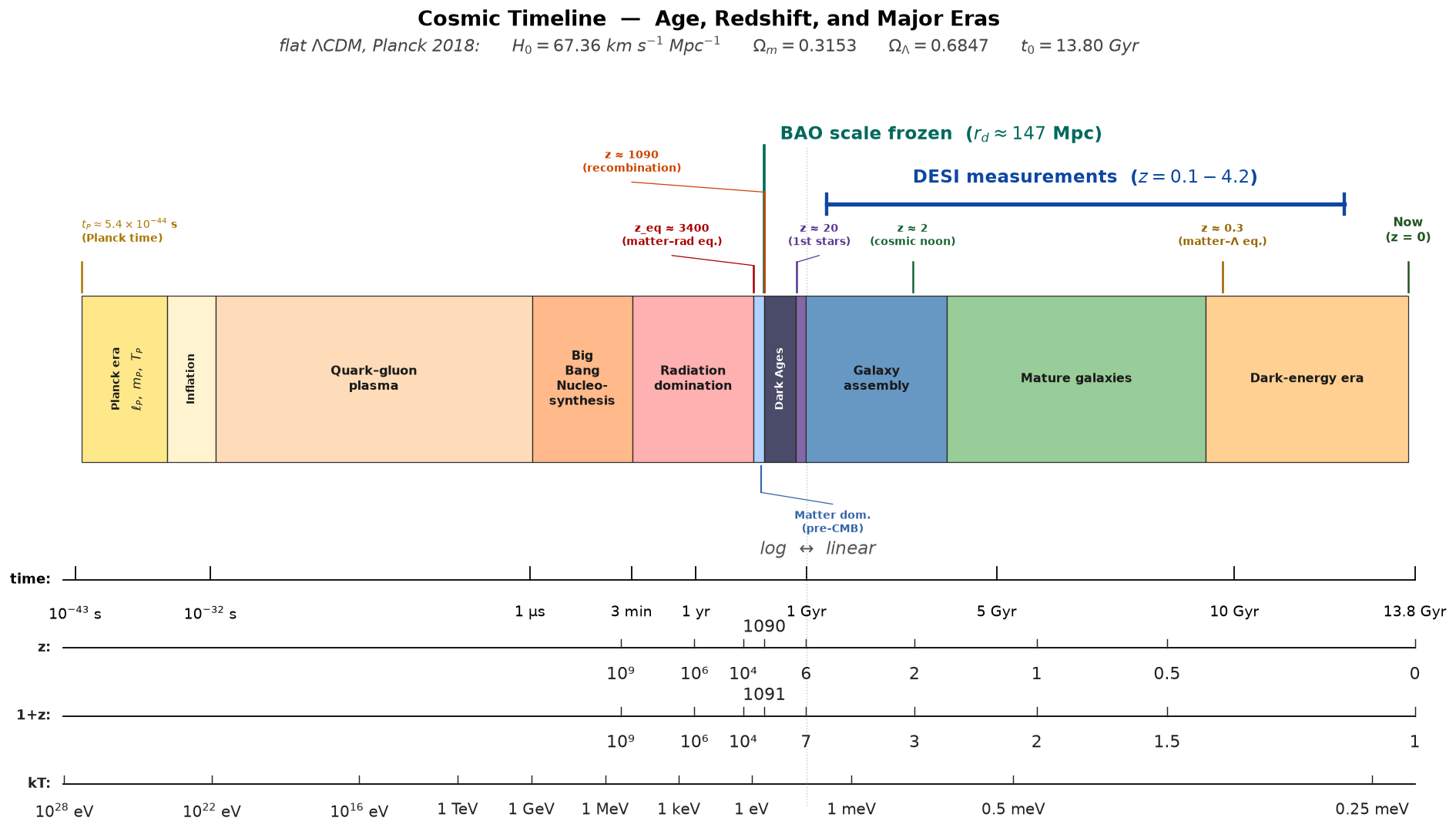
Two crossings do most of the work. At zeq ≈ 3400 matter overtakes radiation, and structure can begin to grow. At z ≈ 0.3 dark energy overtakes matter, and the expansion begins to accelerate.
Two marks above the bar say where this page's subject actually sits. The BAO scale is frozen at recombination, one instant, marked by the vertical line — everything about the standard ruler is decided there and nothing changes it afterwards. The DESI measurements span z = 4.2 down to z = 0.1, which is most of the bar's right-hand half and roughly the last three quarters of cosmic time. The gap between the two is the point: the ruler is manufactured once, in the early universe, and then read off across billions of years of expansion.
By J. W. Rohlf. Source: cosmic_timeline.py (Python, matplotlib).
The six parameters
In its minimal form ΛCDM has six free parameters. They are not the quantities you usually hear quoted — the age, the Hubble constant, the dark energy fraction are all derived. These six are what the fits actually vary.
If you would rather see what they do than read about it, the CMB power spectrum page puts all six on sliders and redraws the microwave background as you move them, with the Planck measurement underneath to compare against.
Two of them carry an h, and it is worth saying what that is before going further. h is the Hubble constant in units of 100 km s−1 Mpc−1 — that is, H0 = 100h, so h ≈ 0.674. It appears because the CMB does not measure Ωb, the fraction of the critical density in baryons. It measures the physical density ωb = Ωbh2, because that is what fixes the sound speed in the plasma and the relative heights of the acoustic peaks. Turning ωb into the Ωb everyone quotes requires h — which is derived, not measured. That is the whole reason h follows cosmology around.
- ωb = Ωbh2 — the physical baryon density. Sets the baryon-to-photon ratio, which fixes the relative heights of odd and even acoustic peaks in the CMB and the freeze-out conditions of Big Bang nucleosynthesis.
- ωc = Ωch2 — the physical cold dark matter density. Controls how deep the gravitational potential wells are, and when matter-radiation equality happens.
- θs — the angular size of the sound horizon at recombination. The most precisely measured parameter in all of cosmology, and the one that pins the acoustic scale.
- τ — the optical depth to reionization. Suppresses small-scale CMB power by e−2τ and produces the large-scale polarization bump.
- As — the amplitude of the primordial scalar power spectrum. The overall normalization of every fluctuation that follows.
- ns — its spectral index. That ns < 1 is firmly established, and slow-roll inflation predicts exactly this sort of small departure from scale invariance.
| Parameter | Planck 2018 |
|---|---|
| ωb baryon density | 0.0224 ± 0.0001 |
| ωc cold dark matter | 0.120 ± 0.001 |
| 100 θ* acoustic scale | 1.0411 ± 0.0003 |
| τ optical depth | 0.054 ± 0.007 |
| ln(1010As) amplitude | 3.044 ± 0.014 |
| ns spectral index | 0.965 ± 0.004 |
| Derived from those six | |
| H0 [km/s/Mpc] | 67.4 ± 0.5 |
| h = H0/100 | 0.674 |
| Ωm | 0.315 ± 0.007 |
| ΩΛ | 0.685 ± 0.007 |
| σ8 | 0.811 ± 0.006 |
| t0 age [Gyr] | 13.797 ± 0.023 |
| zeq matter–rad. eq. | 3402 ± 26 |
| z* recombination | 1089.92 ± 0.25 |
| rd sound horizon [Mpc] | 147.1 ± 0.3 |
Planck 2018 results VI, arXiv:1807.06209, TT,TE,EE+lowE+lensing.
Six numbers is a remarkably small budget for a model that has to reproduce the CMB power spectra, the abundance of light elements, the clustering of galaxies across ten billion years, and the acceleration of the expansion. That it does so at all is the reason ΛCDM is the standard model rather than one option among many.
Cosmology Calculator with BAO Scale
Everything in the table below the rule is arithmetic once the six are fixed, and the Cosmology Calculator with BAO Scale does that arithmetic — expansion rate, age and lookback time, comoving and Hubble distances, their ratios to rd in DESI's convention, and θBAO, at any redshift you type.
Where the standard ruler comes from
Before recombination the universe is a plasma, and photons and baryons are locked together. An overdensity launches a pressure wave that travels outward at roughly c/√3. Cold dark matter feels no pressure and stays put; only the baryons ride the wave. At recombination the photons decouple, the pressure disappears, and the wave stops where it stands — leaving a shell of baryons frozen at the distance sound could travel in that time.
One overdensity, followed from z = 6000 to the present. Blue is
cold dark matter, orange is baryons, and the green ring is the sound wave front.
Watch the two components separate: the baryons are swept outward while the dark
matter stays concentrated at the center. At
z ≈ 1090 the ring stops expanding and the pattern freezes —
a central clump plus a shell, which is why the galaxy correlation function has both
a peak at zero separation and a bump at about 150 Mpc.
Animation by J. W. Rohlf. Source:
bao_animation.py
(Python, matplotlib) — interactive when run locally, with a speed control and frame
export.
That frozen scale is the standard ruler. ΛCDM predicts its length from ωb and ωc — the sound horizon at the drag epoch, rd ≈ 147 Mpc for Planck parameters. Measuring its apparent size at a range of redshifts is how DESI turns a survey of galaxy positions into an expansion history.
Where the model is under strain
Evolving dark energy
ΛCDM assumes the dark energy density is constant — that is what the Λ means. Allowing it to evolve, in the usual two-parameter form where the equation of state runs from w0 today to w0 + wa in the past, DESI's BAO combined with CMB and supernova data prefers evolution over a constant. The preference has persisted from the first-year measurement into DR2. The evolving dark energy calculator puts that two-parameter form beside ΛCDM, and maps which w0 and wa the DESI BAO distances actually allow.
Negative neutrino mass
A second strain shows up in the same fits: when the neutrino mass sum is left free, ΛCDM prefers a negative value — which is unphysical, and a sign that something in the model is being asked to absorb a discrepancy it was not built for.
The Hubble tension
The oldest of the three, and the sharpest. Measure the expansion rate today two different ways and you get two different answers. The early-time route starts from the CMB, uses ΛCDM to evolve it forward, and lands near H0 = 67.4 km s−1 Mpc−1 — the value quoted on the timeline above. The late-time route climbs the distance ladder instead, calibrating Cepheids and then Type Ia supernovae in the nearby universe, and lands near 73. The quoted uncertainties are small enough that the gap is roughly five standard deviations. Both cannot be right.
What makes this a ΛCDM problem rather than a measurement problem is where the difference enters. The distance ladder is close to model-independent — it is geometry and calibrated brightnesses, no cosmology required. The CMB value is not: it assumes ΛCDM in order to turn an angle on the sky into a distance. So a discrepancy between them is either an unfound systematic in one of the two, or a sign that the model connecting them is wrong somewhere between recombination and now.
BAO sits on the early-time side of this, and for a specific reason. What the measurement actually delivers is the combination H0rd, not H0 by itself — the standard ruler's apparent size gives you a distance only once you know its true length. Getting rd requires the early-universe physics, from the CMB or from Big Bang nucleosynthesis. This is why DESI constraints are usually drawn in the H0rd plane, and why BAO on its own cannot settle the argument: it is measuring the product, and the disagreement is about how to split it.
The local side of the argument is not one measurement but a network of them, and it has its own page: the Hubble tension, with the distance ladder drawn out and thirteen routes through it that you can isolate one at a time.
None of the three is yet a discovery. The dark energy result and the neutrino mass result are what the full five-year survey is aimed at; the Hubble tension will need the distance ladder and the CMB to be re-examined against each other, which is already underway with JWST.