The expansion has no center
Click anything in the frame. It stays where it is and the whole sky moves away from it — then click something else, and that becomes the center instead
Two copies of the same sky map are stacked here. One is the sky as it is; the other is the same sky uniformly expanded, every separation multiplied by the same factor. Nothing is added, moved by hand, or singled out. Click anything and the expanded copy is scaled about that point, so the two copies agree there and disagree everywhere else. That object sits still. Everything else slides outward, and the further away it started, the further it goes.
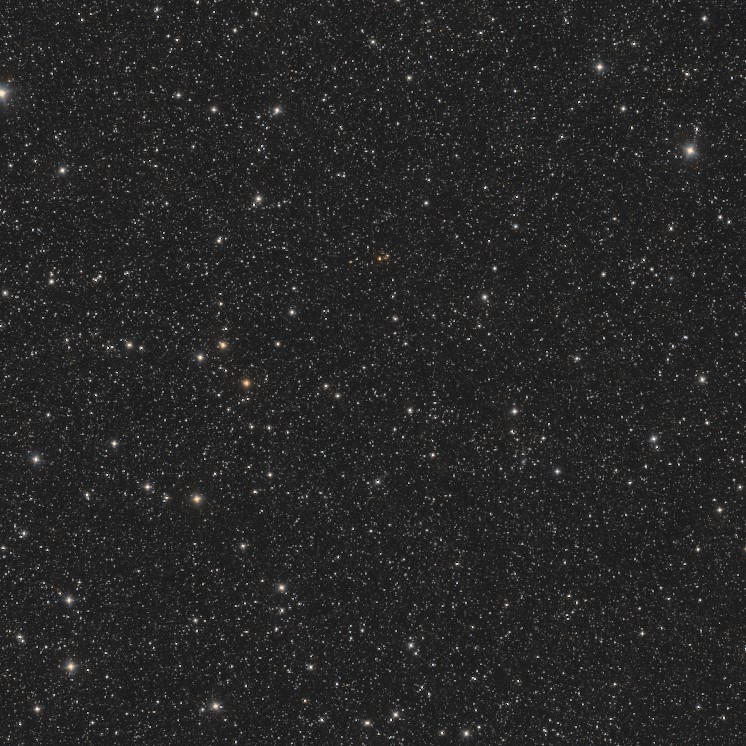
A 4° infrared field at RA 269.730°,
Dec +66.020° — galactic latitude +30°, well off the plane —
from the DESI
Legacy Imaging Surveys viewer, unWISE/NEOWISE W1+W2 at 19.3″ per pixel.
This is the infrared photometry the Legacy Surveys provide for DESI target selection;
the frame holds galaxies together with foreground Milky Way stars.
This follows a demonstration by Viktor T. Toth —
why
cosmic expansion has no center — who is clear that the idea itself is an old
one. His uses a synthetic star field and asks you to drag one copy into alignment;
here the alignment is exact, about whichever object you click.
Why everything looks like the center
Expansion multiplies every separation by the same factor. If two galaxies were d apart and the universe grows by 7%, they are now 1.07d apart, so they separated by 0.07d. One twice as far away separated twice as much. That is Hubble's law, and it is what you are watching: the counterparts near your chosen object barely move, and the ones at the edge of the frame move a long way.
The point is what happens when you click a different object. Nothing about the map changed — the same uniform expansion, the same factor — yet the new one now sits still while the old one races away. Both descriptions are correct simultaneously, which is only possible if neither star is special. An observer on any of them would measure everything receding, and would be entitled to think themselves at the center. That is why the question where did the Big Bang happen has no answer of the form over there: it happened everywhere, and every observer sees the recession from their own vantage.
What the demonstration is and is not. This frame holds galaxies together with foreground Milky Way stars, and nothing in it has been observed to move: it is a picture of the geometry, not a movie of this patch of sky. Anything bound — to the Milky Way, or to a galaxy cluster — is not carried apart by the expansion at all, which is why the effect shows up only on scales where gravity has not won locally. What the two copies show is that uniform expansion looks the same from every point inside it — and a real sky is more convincing than a scatter of dots. For the actual measurement of the expansion at many redshifts, see baryon acoustic oscillations.
Elsewhere on this site
- The same trick on a map of the US the hundred largest cities, where you know where they ought to be
- Cosmology calculator distances, ages and the BAO scale, over a cosmic timeline
- Evolving dark energy calculator what changes when the dark energy density is not constant
- ΛCDM the standard model of cosmology — the six parameters, and the cosmic timeline