Fitting the whole correlation function, not just the BAO peak — the Alcock-Paczyński effect and the growth rate
Fitting the whole shape of the correlation functions rather than the BAO peak alone.
The broadband adds the Alcock-Paczyński effect and the growth rate of structure, at
the cost of a model that must describe non-linear scales.
Cosmological constraints combining these measurements with others are collected under
Cosmological Parameter Estimation. Forest catalogs,
systematics and the pipeline reference set are on the
Lyman-α page.
Galaxies & Quasars
Key paper · DR1
DESI 2024 VII: Cosmological Constraints from the Full-Shape Modeling of
Clustering Measurements
DESI Collaboration · Journal of Cosmology and Astroparticle Physics 07, 028 (2025)
· arXiv:2411.12022
The first DESI full-shape analysis, fitting the two-point clustering of the
bright galaxy, luminous red galaxy, emission-line galaxy and quasar samples to
constrain the growth of structure and test general relativity.
Supporting papers
Loading references…
The DR2 full-shape analysis of galaxies and quasars is in preparation.
Lyman-α Forest
Key paper · DR2
DESI DR2 Results IV: Alcock-Paczyński Measurements from the Lyman-α Forest
and Cosmological Constraints
DESI Collaboration · arXiv:2607.27410 · 29 July 2026
The Alcock-Paczyński effect measured from the full shape of the DR2
Lyman-α correlation functions rather than the BAO peak alone, constrained to
1% precision at z = 2.33 — twice as tight as the BAO
constraint from the same data.
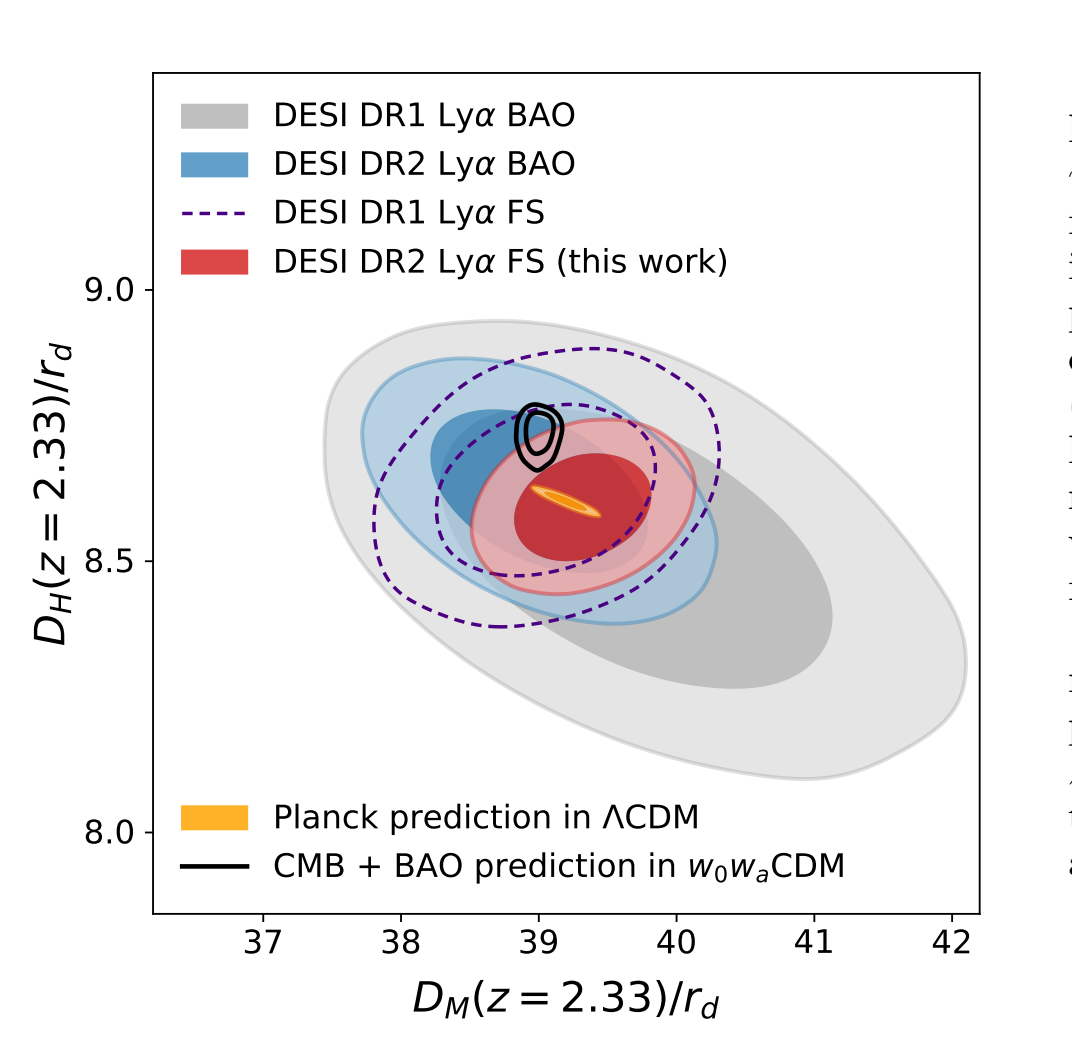
Combining the Lyman-α AP and BAO results gives
DH/rd = 8.600 ± 0.066 and
DM/rd = 39.32 ± 0.33 —
a 6.7-fold reduction in contour area compared with the original DR1 BAO
measurement. With a nucleosynthesis prior and assuming ΛCDM, the forest alone
yields H0 = 66.5 ± 1.3 km s⁻¹ Mpc⁻¹.
The AP measurement corresponds to Ωm = 0.325 ± 0.018,
1.4σ above DESI BAO, easing the tension with the CMB from 2.4σ to 2.2σ. For a
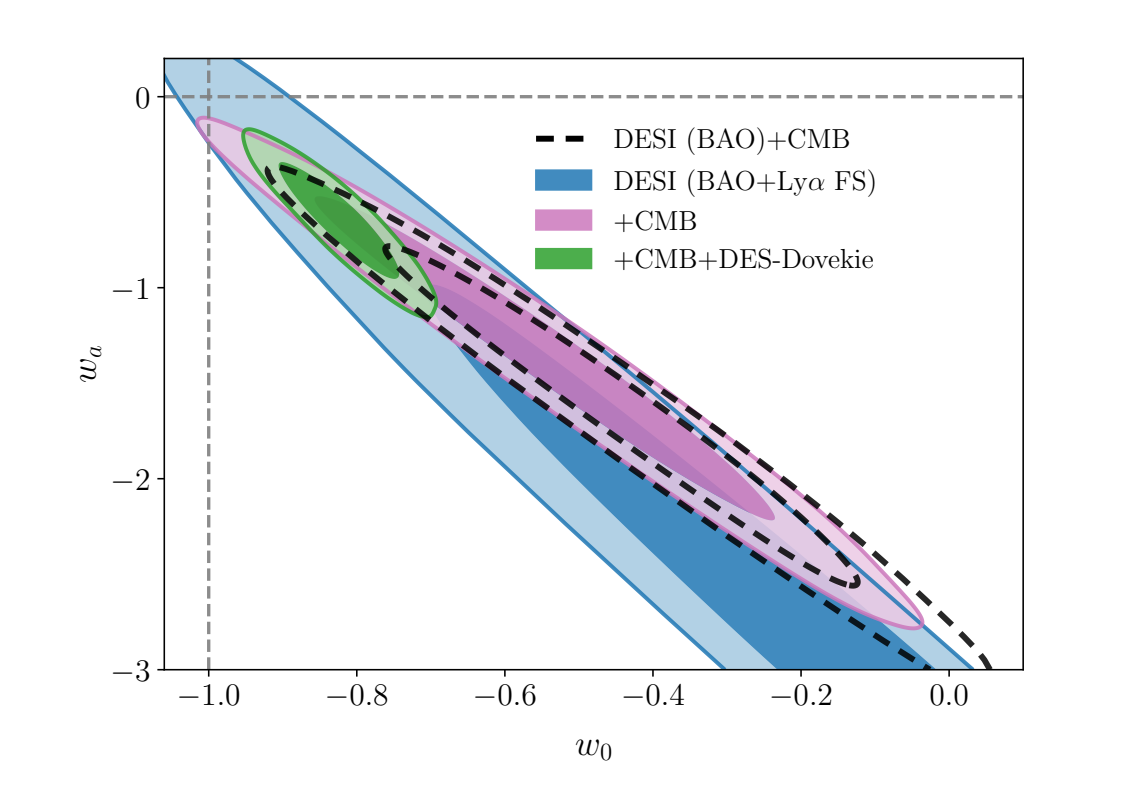
time-evolving dark energy equation of state, DESI and CMB together prefer
w0waCDM over ΛCDM at 2.7σ,
rising to 3.2σ with supernovae. It is DESI's most precise anchor
for the expansion history at z > 1.
Summary drawn from the paper's abstract and Section VI.
Figure 7. Distance constraints at z = 2.33. The DR2
full-shape result (red) is small enough to begin separating the ΛCDM and
w0waCDM predictions.
Figure 10. Dark energy constraints. Adding the Lyman-α
full-shape data shifts the result roughly 0.3σ toward ΛCDM relative to
DESI BAO+CMB alone.
The evolving dark energy calculator lets you move
around this plane and read off what each w0,
wa implies.
Supporting papers · DR2
Released alongside the key paper on 29 July 2026: the validation program completed
before unblinding, the mock catalogs it relies on, and the framework connecting
one-dimensional and three-dimensional forest clustering.
Loading references…
DR1
The 2023 Physical Review Letters paper established the method; the DR1 analysis
applied it to DESI data.