DESI Data Release 1 (DR1)

In May 2021 the Dark Energy Spectroscopic Instrument (DESI) collaboration began a five-year spectroscopic redshift survey to produce a detailed map of the evolving three-dimensional structure of the universe between z = 0 and z ≈ 4. DESI's principal scientific objectives are to place precise constraints on the equation of state of dark energy, the gravitationally driven growth of large-scale structure, and the sum of the neutrino masses, and to explore the observational signatures of primordial inflation.

DR1 consists of all data acquired during the first 13 months of the DESI main survey, as well as a uniform reprocessing of the DESI Survey Validation data previously made public in the Early Data Release. The DR1 main survey includes high-confidence redshifts for 18.7M objects, of which 13.1M are spectroscopically classified as galaxies, 1.6M as quasars, and 4M as stars — making DR1 the largest sample of extragalactic redshifts ever assembled.

In addition to fulfilling its core cosmological objectives with unprecedented precision, DR1 is expected to enable a wide range of transformational astrophysical studies and discoveries.

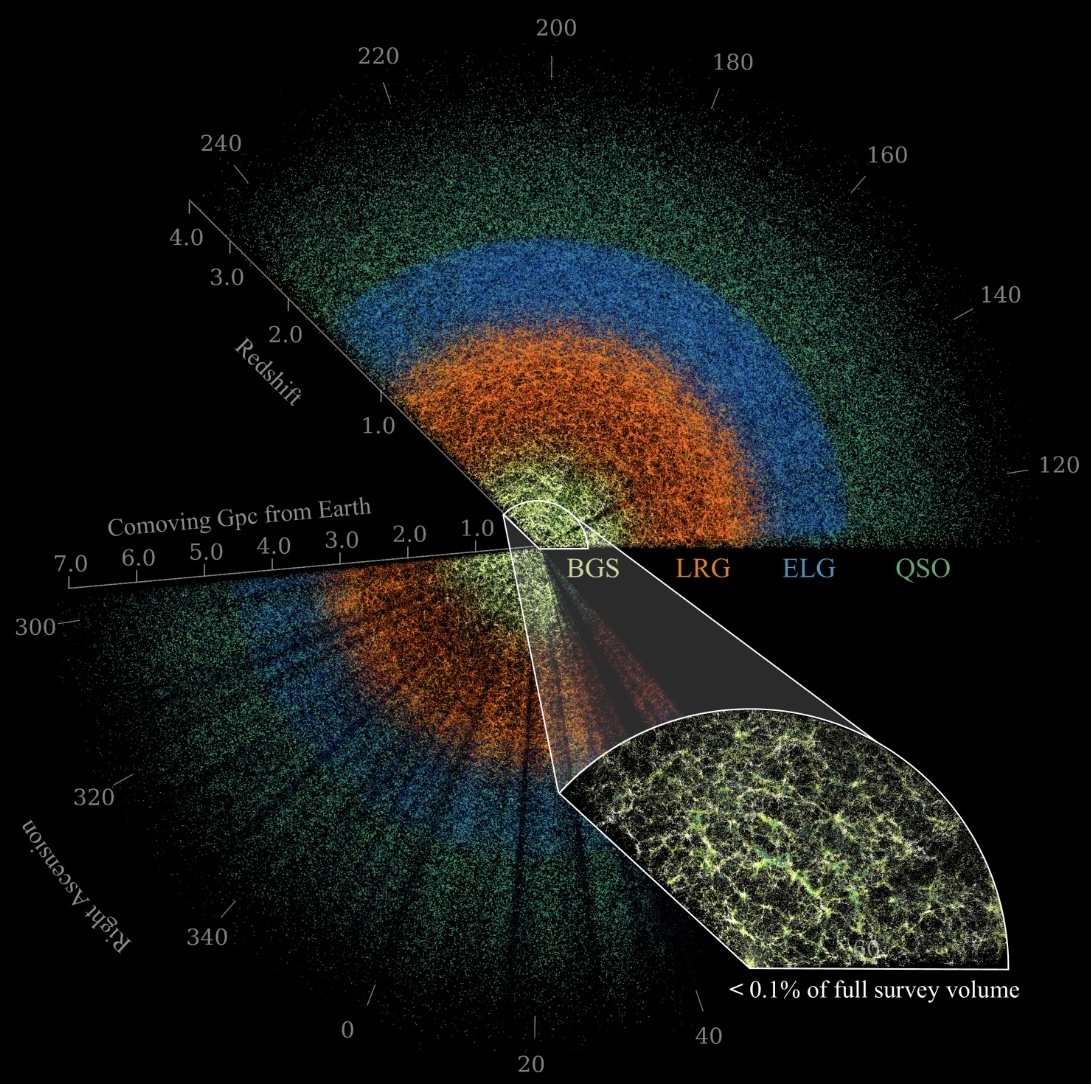
DESI Data Release 1 plotted as two wedges against a black background, with redshift and comoving distance from Earth in gigaparsecs along the radial axes and right ascension around the rim. The four tracer classes are colored separately and each dominates a different shell of distance: BGS in pale yellow nearest Earth, LRG in orange, ELG in blue, and QSO in green furthest out. An inset magnifies a small region into the filaments and voids of the cosmic web, labeled as less than 0.1 percent of the full survey volume.
The DR1 map of large-scale structure. Each tracer class occupies its own shell of distance — bright galaxies nearest Earth, then luminous red galaxies, then emission-line galaxies, with quasars furthest out. That layering is the survey design made visible: no single kind of object is both abundant enough and bright enough to map the whole range, so DESI uses four and hands off from one to the next. The inset magnifies less than 0.1% of the survey volume, far enough in that individual points resolve into the filaments and voids of the cosmic web.
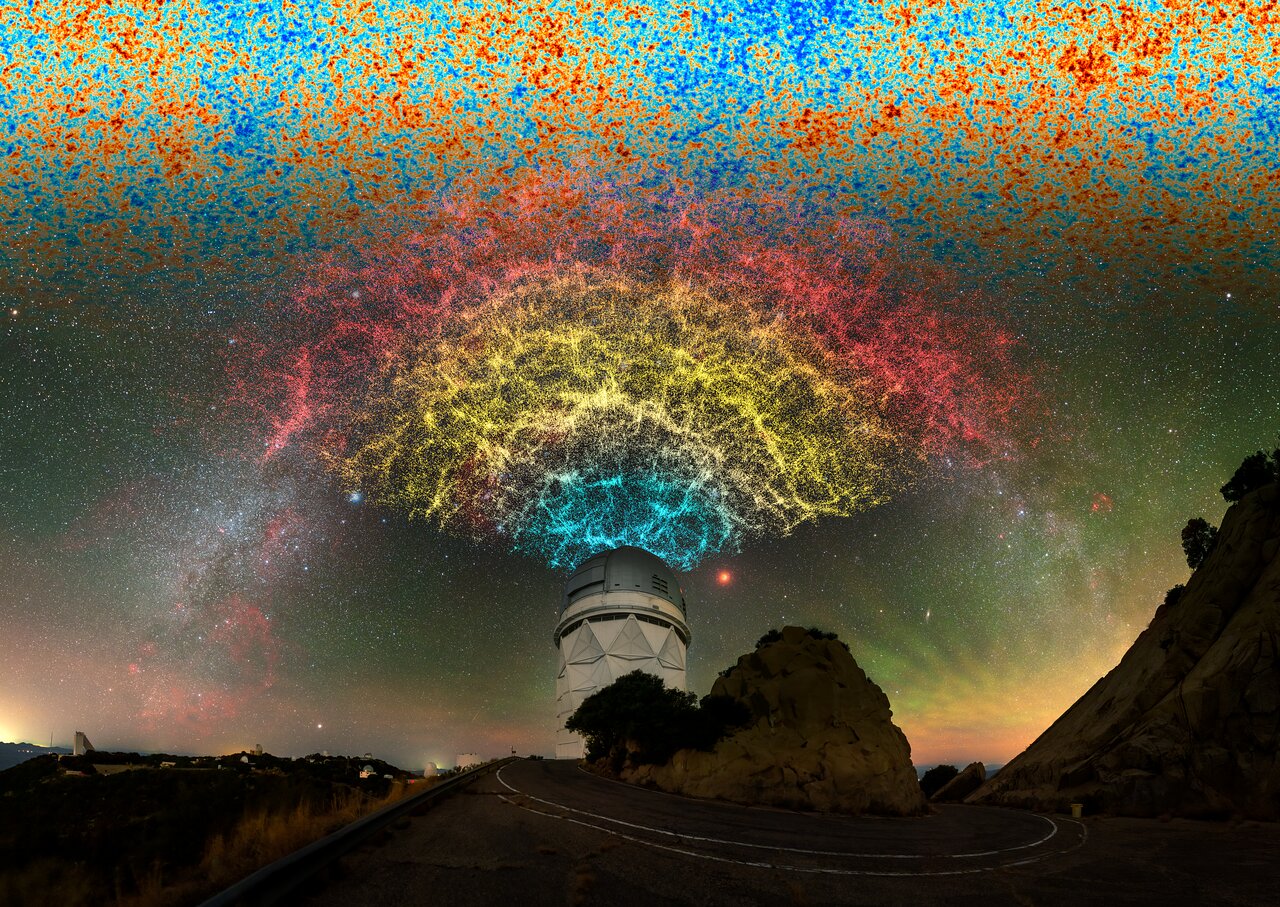
Composite photograph of the Mayall Telescope dome at Kitt Peak at night, with the Milky Way behind it and the access road curving through rock outcrops in the foreground. Rising from the dome into the sky is a fan of the DESI galaxy distribution, colored cyan for the nearest galaxies through yellow to red at the greatest distances, and capped along the top of the frame by the mottled red and blue temperature map of the cosmic microwave background.
A composite. The DESI galaxy distribution rises from the Mayall dome into the sky, colored by distance — cyan for the nearest galaxies, red for the furthest — and the mottled band closing the top of the frame is the cosmic microwave background, the oldest light there is. Read from the dome upward, it is the sequence DESI's map belongs to: the CMB records the density fluctuations at recombination, and the structure below is what those fluctuations grew into over the following 13.8 billion years.
Credit: KPNO/NOIRLab/NSF/AURA/R. T. Sparks